In several conversations about worldbuilding last month (in SFF stories, or any other kind of fiction) we talked about how many or how few details you need to make a coherent and captivating story. In terms of the ‘self-editing’ books, and recent revisions in my novel and other short fiction, I’ve decided it’s a lot less than I may have always figured. Several articles and books suggested that it’s better to leave it to the reader to fill in the gaps, that you should leave some things unexplained on purpose, in order to better immerse them in your world and the minds of your characters. This blog post about the subject points out this ‘lacunae’ in the details as a means to making it feel more real:
Worldbuilders want their worlds to feel real but it’s hard to get that feeling from an exhaustive survey. Lifelike worlds aren’t built from the top down, but from the characters and their surroundings out. They allow for ambiguity, lacunae in our knowledge, the way reality feels no obligation to make sense. Exhaustive worldbuilding aims for worlds logical enough to be mastered, which aren’t worlds at all but clockwork orreries. We can hear the gears click.
That same blogger has another article explaining Borges’s story Tlon, Uqbar, Orbis Tertius in these terms that I highly recommend checking out if interested.
For me, this is how I’m thinking about my worldbuilding right now: try to expose world details only when the characters’s action demands it, choose only a handful of world details to describe throughout the story in order to sharpen the focus for the reader (leaving the lacunae between those details), and resist the urge to info dump anything that is not immediately relevant to the story. I mentioned the ‘truths table’ in another letter, and since then I’ve used one to organize my ideas in my manuscript and it feels like it’s working/helping.
Another trick I’ve dabbled with is something that another blogger calls ‘Hyperdiagesis’. It’s the idea that you drop names or references to things in your world — diagetic things that occur/operate in your world — but do not explain anything beyond the mention. An example of this might be phrases like The Great Cataclysm or nobody returns from the Void Realm. They probably need to be evocative, and in themselves stir up some kind of imagination or spark. But the ‘hyper’ extension of this idea, at least in the realm of TTRPGs, is that it will entice the players to later explore and add depth to those things and in turn their own characters/experiences.
One example from my life, I drew a simple regional map for one of our house games that included a water feature between two mountains that I labeled Horsemore Lac. That was all I added, no backstory or other details, and no clue what happened there. My wife, a player in our current game, ran with the idea and developed an entire character with a back story and regional history via this simple/shallow reference (the lake itself is probably much deeper). I think the way it might work in fiction could be that by dropping these references to say ‘the Void’ or ‘the cataclysm’ early on, you entice your readers and can later explain it more fully, as in you drop the name in Act 1, then explain it more fully toward the end of Act 2. I think I’ve had some success with this approach, especially in my shorter scribblings.
Another thing worth mentioning here is the exciting arrival of a new book of random tables called The Tome of Worldbuilding, from the creators at Mythmere Games. I backed the project on Kickstarter and received the PDF this week (printed books are still in the works). But much like their legendary creation, The Tome of Adventure Design, the designers/writers have created a true artifact of inspiration.
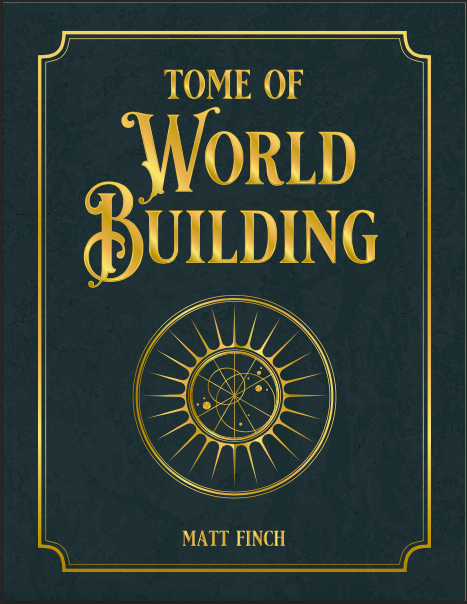
I’ve only skimmed the introduction, but the new tome has both a systematic plan/method for designing a fantasy world and a more ‘à la carte’ approach (as they call it) for picking and choosing random elements that might spark your creative mind. I’ve had a lot of success with the original Tome in building fantasy worlds in my RPG games or fictions, and hope the new wourldbuilding edition will only expand on that original concept. The number of tables in itself can be overwhelming, and it’s best to use them in chunks, or within a specific context. I’m excited to apply the book’s new method to my existing fantasy worlds in the coming weeks.