*Culled from a longer thread about visual art in relation to your writing
Part of my extra-curricular reading and research has involved reading about the varying human efforts — current and historical — to talk to whales. Much of it started with humans listening to their songs and the grand efforts of scientist Roger Payne in the 1960s and 70s to record and catalog these songs into a listenable pressing on vinyl, which in turn helped ban the practice of commercial whaling in nearly every country worldwide. Payne’s work was published in Science magazine and they even used his spectrogram charts for the cover:
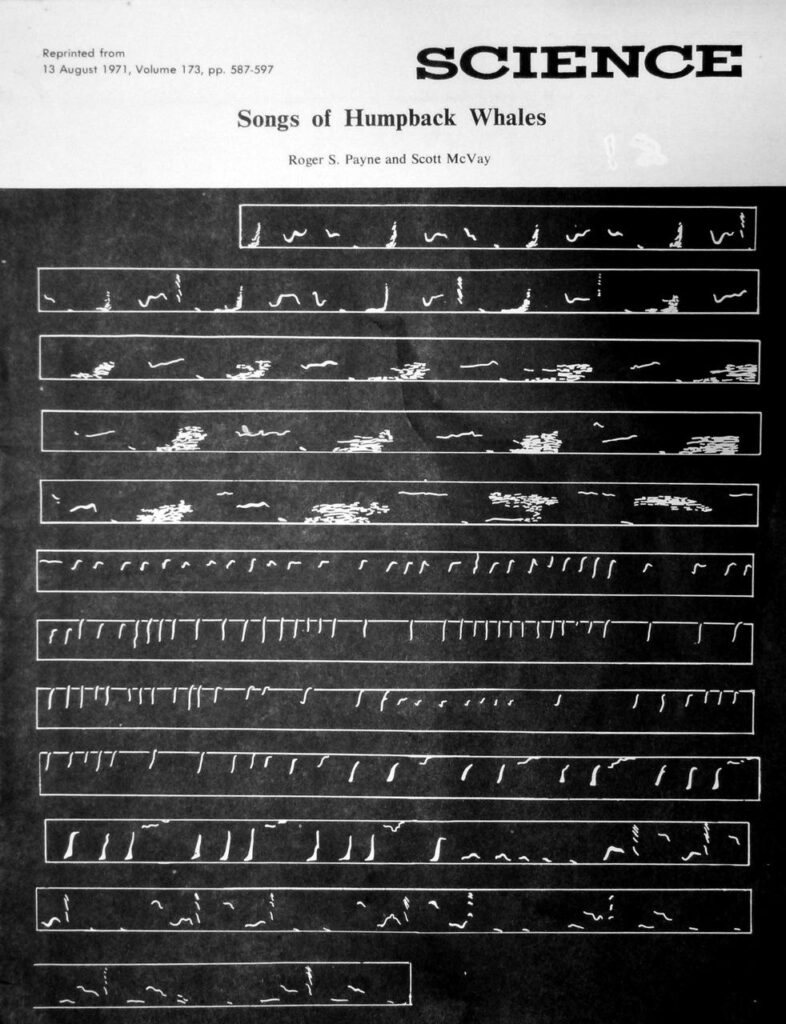
I can think of nothing better than this image of these whale songs in print to add to my growing art board. Seeing these songs in print like this, akin to musical notation, that and its eerie, analog otherworldliness in black and white, takes me to the specific place in my mind I feel need to be while revising this story. Here is one more spectrogram image because I can’t help sharing:
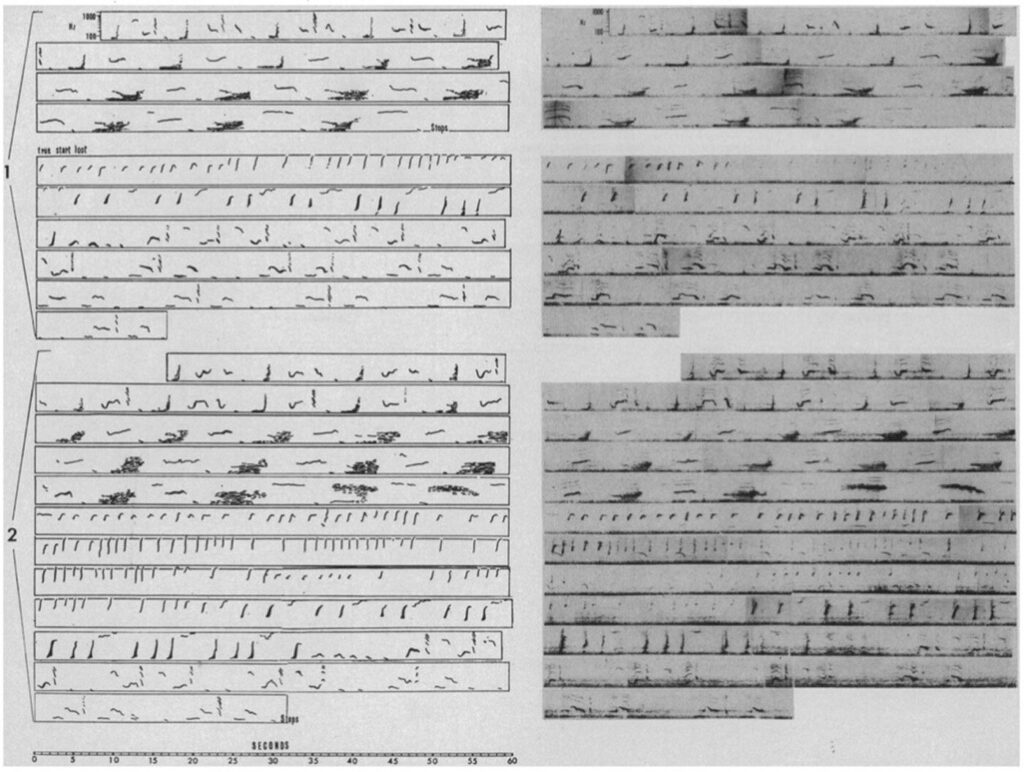
I highly suggest having a listen to Payne’s original recording. Payne’s work continues to this day in many forms, and new attempts now focus on harnessing the power of AI tools to get to the heart of these songs. But despite those efforts, there is something captivating — and perhaps even fulfilling — about simply looking at these strange alien artifacts from earth, knowing that we might never know what they mean.
I’m sure more charts like this will end up in my art board collection before I’m done with this draft. Maybe once it’s complete I will share the completed document here. I wanted to say something more about combining these images with music, but I think I’ll save that for another letter too. These whale song charts combine both ideas at once and are more than enough for now.
A few thoughts on AI
Reading about research into human-animal communications, and the new applications of artificial intelligence tools, like the large language models that are slowly memorizing the world’s data, has got me excited and feeling that a sudden breakthrough could be on the horizon (ie the CETI program). Perhaps in only months, or even next year, we might have a successful means or app to communicate with another animal species on earth. But like most things in the tech world, and in particular anything surrounding AI right now — in which the common refrain is that artificial general or super intelligence is right around the corner — that hype is driving investors, and most likely not the reality.
Another book that’s become part of my research for the novel is called How to Speak Whale, by Tom Mustill (2022 Grand Central Publishing). In it, the author gives a passionate and thorough account of how we are going about trying to talk to animals or if it’s at all possible. I’m not quite finished with it yet, but I think the author’s answer in the end will not be definitive one way of the other, given that despite our technological means, there are plenty of other factors that would complicate things. More importantly, the author asks the questions about why we would speak to whales in the first place, and brings up the obvious differences in our perceptions of reality that must be a factor in this endeavor. Either way it’s a big assumption to say that translating one whale song would unlock the key to all songs planet wide, when whales are known to swim in unique collectives, or pods. and might even display certain ‘cultural’ differences in different parts of the ocean.
This of course is another rabbit hole. I won’t take you any further here. Instead, I’ll leave you with something that I heard but can’t remember the exact source. The paraphrased idea suggests we might be better off watching specific groups of animals in regards to specific locations (a notion that drives an important element in my work in progress). Here is the rough quote pulled from where I scribbled it in the notes on my phone:
The most elegant and profound discoveries of animal behavior have come from knowing individual animals, and watching them and tracking them and just being present.
The specificity of location of the one observed, and the individual’s — whether it be human or animal — relation to that place in terms of the world, might be enough to squash my anxiety about any AI news that I hear tomorrow. For now it’s enough to get me through this round of revisions.